„A republic, if you can keep it.“ (e)

Image Source US National Archives
There are certain phrases that keep going round and round in your head, especially lately, when you might almost think you have to get used to destruction and decadence. The famous quote above was dusted off in the press for the first time when Trump botched his reelection bid and sent his mob toward the Capitol. It was hard to believe how quickly it all happened. Good things happen slowly, bad things happen fast.¹
The American Revolution of 1776 was not generally referred to as such during my school days, but rather as the struggle for independence. At least that’s what my textbooks still say, and that’s why I’m still so conditioned to believe that the French Revolution was the actual beginning of the end of the monarchy. Yet the New Englanders got there more than ten years earlier. We’ll be hearing that often enough over the course of this year. However, American democracy was on shaky ground from the very beginning. It wasn’t until 1787 that the decisive Constitutional Convention took place in Philadelphia. At the end of the convention, the famous dialogue between the hostess, Elizabeth Willing Powel, and Benjamin Franklin took place.
After the delegates had finished their work and Franklin left the building, Elizabeth Willing Powel is said to have asked him, “Well, Doctor, what have we got, a republic or a monarchy?” Franklin replied with the famous words, “A republic, if you can keep it.”
Nothing is certain simply because it is good. Franklin, a man of good character, knew all too well that the new, republican form of government would not necessarily endure. Its survival depended – and depends – on the political virtue, commitment, and vigilance of its citizens. To this day, this statement serves as a powerful reminder to actively protect and nurture democracy.
__________
¹ American jazz pianist Fred Hersch, who had to come to terms with a devastating diagnosis in the middle of his life, used his doctor's comment as the title of his memoir.
Upload on YouTube by Sotheby's


Typography of the Enlightenment – Available for Purchase at Sotheby’s
The purpose of the printed material presented in the video was to ensure that the ratification process proceeded as quickly and democratically as possible. To this end, a formal, six-page document was typeset, structured systematically like a preliminary contract, with space provided for signatures and initials. The 500 copies, produced by hand, were then sent by courier to the relevant cities, districts, and municipalities so that a binding vote on the new constitution could be held through grassroots democracy. A historic document and a prime example of Georg Christoph Lichtenberg’s aphorism: “Lead has changed the world more than gold. And more than the lead in a shotgun, the lead in the type case.” His conclusion can no longer be accepted without reservation. In this regard, we have since been thoroughly stripped of our Enlightenment romanticism.
Nevertheless, there is something deeply reassuring about seeing thoughts, positive demands, and well-intentioned goals so precisely articulated and thus preserved as universally binding. Despite all the hot air, the American ruling elite has always been one step ahead. The reproduction and rapid dissemination of progressive ideas as the key to power – PR in the style of the new era.
If you Google the U.S. Constitution, you automatically come across the calligraphically embellished version, which seems completely out of step with the times in terms of its form. John Dunlap’s printed sheets, on the other hand, are elegant and clean. Logically, the consistent use of the Antiqua typeface also comes into play here. This is quite different from, for example, the writings of Immanuel Kant, which were set entirely in Fraktur. By the way: A nice bit of trivia that I also enjoy pointing out to my students is the use of the two forms of the letter “s.” Even in the Anglo-American world, both the long “s” and the final “s” were used well into the 19th century. The “ß” as a ligature had not yet been invented.
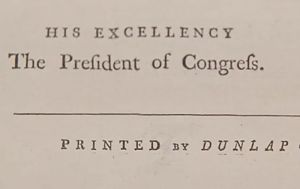
Long “s” and final “s,” even in Roman typesetting
With the 250th anniversary of the American Declaration of Independence, we still have a tough test ahead of us this year. Personally, I’m pretty sure I’ll feel sick watching the clowns in the U.S. administration engage in self-congratulation. Nevertheless, the history of the American Revolution is fascinating. As part of their “What Happened So Far” series, historians and journalists Joachim Telgenbüscher and Nils Minkmar have recorded six podcast episodes that immerse us in the incredible dynamism of the New World. Highly recommended.
What's Happened So Far – History Podcast (German only)
Die amerikanische Revolution, Folgen 1-6