Lee Miller, Photographer, 1907-1977 (e)
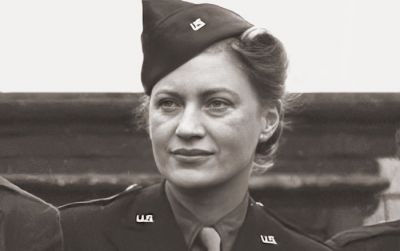
Image source Wikimedia Commons
Lee Miller first appears on the fringes of art history – as a model, muse, companion, and assistant to Man Ray – standing, like many other women, in the shadow of a famous man. However, in addition to her talent as a photographer and writer, Lee Miller possessed an absolutely astonishing drive and inner restlessness that, while putting her in grave danger, ultimately made her one of the most important journalists of World War II. Throughout her young artistic life, Lee Miller traversed the entire spectrum – from art, bohemian life, and the glamorous world of fashion to the depths of the war’s most horrific scenarios.
For many years, actress Kate Winslet fought to bring Lee Miller’s life to the screen during its most pivotal phase. Quite apart from the fact that, in my view, the actress herself doesn’t quite fit the mold of Lee Miller, Winslet’s portrayal in the cinematic adaptation of this true story is a magnificent professional achievement – one that is emotionally gripping. What is consistently compelling is the cinematically sensitive portrayal of a horror that is gruesome in every respect. The images are stark, shameful, and oppressive. Yet Ellen Kuras’s level-headed direction consistently maintains a distance from sensationalistic war action.
A quick flip through the photo book “Lee Miller, Photographs” Elisabeth Sandmann Verlag
The film references many well-known, long-iconic images. This is not unusual, but it is executed superbly and with absolute authenticity, both in Paweł Edelman’s cinematography and in the film’s overall production design. During the credits, some of the film’s scenes are juxtaposed with the originals. A selection of these is featured in the illustrated book, which was published in 2023, after filming had wrapped.
We follow the protagonists from the sunny life of the artistic avant-garde abruptly into horror; from one moment to the next, horror and grief become something we can personally relate to, in the face of the unstoppable violence plaguing Europe. In this deadly serious situation, Lee Miller impulsively heads to the front lines. As a reporter for the British Armed Forces, she is initially denied access, but as an American citizen, she is able to demand it. She accompanies the U.S. Army during the invasion and the liberation of Paris, photographing and reporting on the camps at Dachau and Buchenwald.
Why exactly she, with her artistic sensibility as a fashion photographer, ventured into the depths of human malice in this situation remains a mystery. However, she could not have even remotely imagined the horror that awaited her there. We know everything today, and that is precisely why it is our duty to take note of every form of violence with the utmost attention and to be honest with ourselves when it comes to how we assess and deal with violence. I strongly doubt that the succinct hippie mantra “make love, not war” is enough.
„Never forget, never forgive!“
Lee Miller had this line of text added beneath one of the harrowing photos from Dachau. It’s impossible to look away. One cannot intellectually reject raw violence. Against physical violence, one can only protect oneself preventively—or one must endure it. One cannot philosophically dismiss it. An unassuming line in the film sums it all up: “Even if I wanted to look away, I couldn’t.” That is why Lee Miller later had most of the photos she took during the war stashed away in the attic—a vague way of avoiding having to look at them anymore.
In fact, the British were the first to lock away their concentration camp film reels in archives—if only for the sake of their own peace of mind. Only American Vogue had published Lee Miller’s harrowing documentation in 1945. It’s also strange to see today’s fashion world reporting on the film in general and Kate Winslet’s wardrobe in particular. If you scroll down in this article, you’ll find the legendary feature “Believe It.” Even back then: alongside the latest collection, suddenly piles of corpses from the chambers of horror at the Dachau and Buchenwald concentration camps.
Kate Winslet on War Photographer Lee Miller, and the Film She Was Born to Make
Flashback to 1986 – I remember chatting with a neighbor shortly after I’d moved to Munich. She wanted to know if I’d explored the surrounding area yet. “Have you ever been to Dachau?” She said it was absolutely beautiful and that the cake at the Schlosscafé was highly recommended. I was at a loss for words. The “hiking highlight” below is of a similar caliber:

The Difficult Issue of Pacifism
It is becoming increasingly clear to me just how disastrous—or rather, hopeless—even the most well-intentioned pacifism would ultimately be. The extreme example of World War II and the reactions of the resistance clearly show how appeasement and a love of peace fall by the wayside when things really go wrong. Consistent pacifism – which, by the way, I consider a mere assertion – subtly leads to the trivialization of violence, precisely because it assumes that one would even have a choice if push came to shove. One does not! And in my view, the discussion about this is intellectual posturing that leads only to frustration – strangely enough, often accompanied by aggressive mutual accusations. Thus, it’s easy to deny one’s political opponent moral authority – as it were, from the sidelines – as the extreme parties are currently doing so eagerly. After all, one bears no responsibility for one’s own rhetoric. For example, the BSW – of all parties, a group sympathetic to Putin – is putting up posters asking, “War or peace?” It hardly gets any more hypocritical than that. Discussions about pacifism only make sense before a war. During the war itself, they’re pointless – by then, it’s too late.
The legal concept of conscientious objection also suggests a deceptive ideal – namely, that one can, in fact, resist raw violence through sheer willpower. One cannot resist violence any more than one can resist an illness that strikes out of the blue. As with a serious illness, one can only prepare for it and, when confronted with it, fight against it. One can only evade impending violence, escape it, avoid it preventively, or ultimately confront it with violence oneself. But it is dangerously naive to hope that this problem will not arise if one simply remains a good person.
Although Lee Miller hated all Germans indiscriminately until the end of her days, as a German child of the postwar generation, I take the liberty of admiring her – whether I have the right to do so or not.
A useful link Zehn Leben in einem ("Ten Lives in One")
"Deutschlandfunk Kultur" currently has a very good compilation
featuring this extraordinary artist.


P.S.: March 6, 2025 – Exhibition at the Amerikahaus, Munich Audioguide

Lee Miller's Estate Archive-Website